They Had the Mountain. They Had the Plans. They Never Built a Single Lift.

I spend a lot of time thinking about the ones that didn't get built.
Not just ski areas — all of it. The subdivisions that stalled in permitting. The resorts that broke ground and ran out of money. The mixed-use developments where the vision was right and the execution was wrong, or the timing was right and the politics were wrong, or everything was right and the market moved anyway.
Ski Magazine ran a piece recently about the six coolest resort proposals in U.S. history that never opened. You've probably heard of some of them — Disney's Mineral King valley in California, the Catamount resort near Steamboat that went under twice. Spectacular vision. Spectacular failure. The West gets most of the headlines.
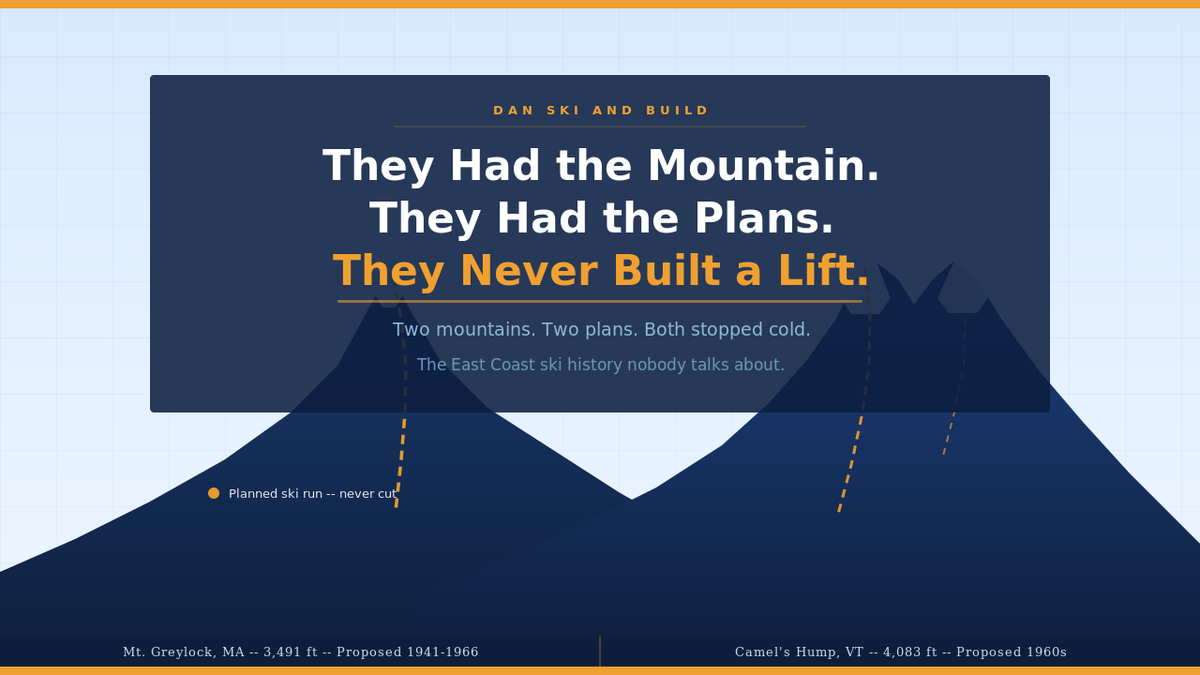
But the East has its own graveyard of almost-mountains. Two of them have been living rent-free in my head since I started digging.
One is in Massachusetts. The other is in Vermont. Both had serious capital, serious planning, and serious backing — at the governor level. Both are still sitting there today, untouched, drawing thousands of hikers every year to the exact terrain that developers once planned to turn into chairlifts and base lodges.
Here's what happened, and why I think about them differently than most people do.
MOUNT GREYLOCK, MASSACHUSETTS: THE MOUNTAIN THAT ALMOST HAD EVERYTHING
Let's start in Adams, Massachusetts, at the top of Mount Greylock — 3,491 feet, the highest point in the state, and one of the most storied pieces of terrain on the entire East Coast.
Most people don't know the skiing history here, but they should.
In 1934, the Civilian Conservation Corps — the same Depression-era federal program that built half the infrastructure we're still using today — cut a trail down the east face of Greylock called the Thunderbolt. Forty-five hundred feet of vert compressed into a steep, unforgiving line that ski racers from around the world came to test themselves against. By 1935, the Massachusetts State Downhill Championship was being held on it. By the late 1930s, the Thunderbolt was an international event drawing Olympians and 7,000 spectators — traveling up by train from New York City.
In 1938, the Third Reich sent a ski team.
Let that land for a second. Nazi Germany dispatched Fritz Dehmel to the Thunderbolt to prove the superiority of German athletes in front of a crowd of thousands. He narrowly beat Rudy Konieczny — the local favorite from Adams — in the Eastern Downhill Championships. The trail was that serious. The mountain had that kind of gravity.
The FIS held its last sanctioned race on the Thunderbolt in 1948. And then — slowly, quietly — the trail grew over.
But the mountain itself didn't disappear from developers' minds. Far from it.
THE PROPOSAL
The first aerial tramway proposal at Greylock came in 1941. It went nowhere. Then in 1953, Governor Christian Herter of Massachusetts appointed a five-man committee to assess the mountain's potential and established the Mount Greylock Tramway Authority — specifically modeled on Cannon Mountain's tramway in New Hampshire, which had become a major economic engine for Franconia Notch. The logic was sound: the declining textile mill economy in Adams desperately needed a new driver, and Greylock was sitting right there with world-class terrain and an established ski legacy.
By 1964, the plan had grown to something genuinely ambitious: a $5.5 million development by Fay, Spofford, & Thorndike, Inc. of Boston, with four chairlifts, an aerial tramway, eleven miles of ski trails, an "international shopping center," and an amusement park. By 1966, Phase 2 had been added — three more chairlifts, a hotel, a golf course.
There were serious people involved. Sel Hannah — one of the most respected ski trail designers in New England history — surveyed the proposed area. The governor's office backed it. Regional tourism groups backed it. The town of Adams needed it.
WHY IT NEVER HAPPENED
The Mount Greylock Protective Association filed suit.
Despite years of effort, the Tramway Authority couldn't sell enough bonds to finance the project. The legal challenges from conservationists stretched the timeline. And in 1966, the Massachusetts Supreme Court abolished the Mount Greylock Tramway Authority entirely. The Legislature followed with legislation to kill it for good.
The development didn't just stall. It was litigated out of existence.
WHAT IT LEFT BEHIND
The Thunderbolt is still there. Maintained today by a small group of volunteers, it's skiable again — a backcountry classic, not a resort run. The summit is a stunning hike. Greylock is beloved by Massachusetts residents and largely unknown to anyone else.
The town of Adams, which the tramway was supposed to revitalize? It's still waiting for that revitalization. Population: under 8,000. The old mills never came back. The resort never arrived.
What strikes me as a developer isn't the failure of the vision. The vision was right — the terrain was real, the market demand was real, the economic need was real. What strikes me is how the execution window closed. The legal and regulatory environment that existed in 1960 was completely different from the one in 1966, and then again in 1970 when NEPA arrived. There was a window. It didn't get used in time.
After 1970, you essentially couldn't build a new resort on public land in this country. Beaver Creek and Deer Valley squeezed through just before the door shut permanently. Greylock's developers didn't.
The lesson isn't that the project was wrong. The lesson is that timing is everything, and when your capital raise stalls and your legal challenges pile up, the window moves without you.
CAMEL'S HUMP, VERMONT: THE MOUNTAIN ON THE QUARTER
Now let's go north.
Camel's Hump is 4,083 feet — tied for the third-highest peak in Vermont — and it might be the most recognizable mountain silhouette in New England. Its distinctive twin-hump profile appears on the Vermont state quarter. It's on the Vermont flag. It was named by Samuel de Champlain in 1609.
It is also, as its admirers will proudly tell you, the only undeveloped alpine area in the Green Mountain State.
That's not an accident. That's the outcome of a deliberate fight — and the fight has a development story at its center that almost nobody talks about.
THE PROPOSAL
In the 1960s, Vermont was experiencing the same boom in ski development that was transforming the rest of New England. Stowe was expanding. Killington was growing into a destination. Mad River Glen had its devoted following. And developers looked at Camel's Hump — a 4,000-footer sitting less than 20 miles from Burlington, with sustained vertical drop and a terrain profile that would make any ski area designer's eyes light up — and saw opportunity.
Proposals circulated through the early-to-mid 1960s. The state's natural areas were not yet formally protected. Camel's Hump was state-owned land, having been donated by publisher Joseph Battell in 1905 with the wish that it be kept "in a primitive state" — but that original bequest was not legally binding on the state.
The mountain was genuinely on the table.
WHY IT NEVER HAPPENED
The conservation movement was gaining momentum faster than developers could move.
In 1968, the National Park Service designated Camel's Hump a National Natural Landmark. In 1969, Vermont passed special legislation creating a Forest Reserve around the mountain — effectively locking it away from commercial development. The timing was no coincidence. Environmental groups, conservationists, and citizens who loved the mountain for what it was had organized, lobbied, and won.
Two years later, NEPA arrived nationally. By then, it was already over for Camel's Hump.
WHAT IT LEFT BEHIND
The mountain is spectacular. The views from the summit take in Mount Marcy in New York, Mount Washington in New Hampshire, and Mount Mansfield across the valley. There are 10 acres of alpine tundra at the summit — rare, fragile, genuinely worth protecting.
And Burlington — which would have had a world-class alpine destination less than 20 miles from downtown — has exactly zero major ski mountains nearby.
I'm not saying the conservation decision was wrong. I'm genuinely not. The mountain is beautiful and the tundra ecosystem is rare and some things shouldn't be developed.
But I do think about what the development community failed to do in time. The Camel's Hump proposals never got to the stage of a specific sponsor, a specific capital structure, a specific plan. By the time serious development interest materialized, the conservation movement had better organization and better political access than the development side. The regulatory environment shifted against them not because their project was bad, but because they were slower.
When you're racing against a regulatory clock and you don't know it's ticking — that's when you lose.
THE PART NOBODY TALKS ABOUT
Ski Magazine frames these stories the way most people frame them: as tales of dreams that didn't come true. The visionaries who imagined something great and got stopped by lawsuits and bonds and environmental boards.
I read them differently.
Both of these mountains had the fundamentals right. Terrain. Proximity to population. Economic need. The gap wasn't the vision — it was execution timing, capital structure, and the failure to recognize that the political and regulatory environment was moving faster than the development timeline.
Mount Greylock's developers spent over a decade trying to sell bonds that never sold. Every year they waited, the conservation opposition organized more effectively. By the time the 1964 plan was fully formed, the window was already closing.
Camel's Hump never even got to a formal proposal with committed capital. The developers were interested. They weren't organized. The conservationists were.
This is what I think about whenever I'm underwriting a development in a market with regulatory complexity or conservation interests at play. The question isn't just "can this project pencil?" It's: how long can this project wait? Because the environment you're underwriting in today is not the environment you'll be delivering into in three years. And if your capital structure requires you to sell bonds in a market that might move against you — that's the risk to price.
The developers at Greylock didn't lose because the mountain was wrong. They lost because time ran out.
A NOTE ON WHAT'S STILL POSSIBLE
No new major ski resort has been built in the United States since Deer Valley and Beaver Creek opened in 1980 and 1981. The regulatory, environmental, and economic barriers are real and essentially prohibitive at that scale.
But the mountains are still there.
Greylock's Thunderbolt is being maintained by volunteers who believe in it. There's active conversation in the backcountry skiing community about what a non-lift-served, low-footprint operation on that terrain could look like. Camel's Hump gets 26,000 hikers a year through two trailheads — demand that any developer would kill for, served by zero commercial amenities.
The era of the grand destination resort may be over. The era of adaptive, community-scaled, experience-first development in ski country is just beginning.
That's a different thesis than what the 1960s developers were running. But it's the right thesis for right now. And the mountains haven't moved.
YOUR TURN — I WANT TO HEAR FROM YOU
A few questions I'm genuinely sitting with after going deep on this:
If you had a $10 million budget and a blank permit to do something thoughtful on the Thunderbolt — not a resort, but something meaningful — what would you build? A backcountry hut system? A small trailside lodge? A race event series with overnight accommodations? I don't have a right answer here, I'm actually curious.
Do you think the conservation decisions at Greylock and Camel's Hump were right? With fifty years of hindsight — the economic struggles of Adams, the underdevelopment of Burlington's ski scene — would you call it differently?
Are there other East Coast mountains in this category you think deserve more attention? I'm just getting started with this research and I know there are more stories out there.
Drop me a line. I read everything.
Dan Kaufman skis, builds, and thinks too hard about the intersection of both.
danskiandbuild.com