The Mountain Doesn’t Make the Community. The People Do.
By Daniel Kaufman | Dan Ski & Build
I can’t tell you where I was.
Not yet, anyway. More on that in a future post — and trust me, it’ll be worth the wait.
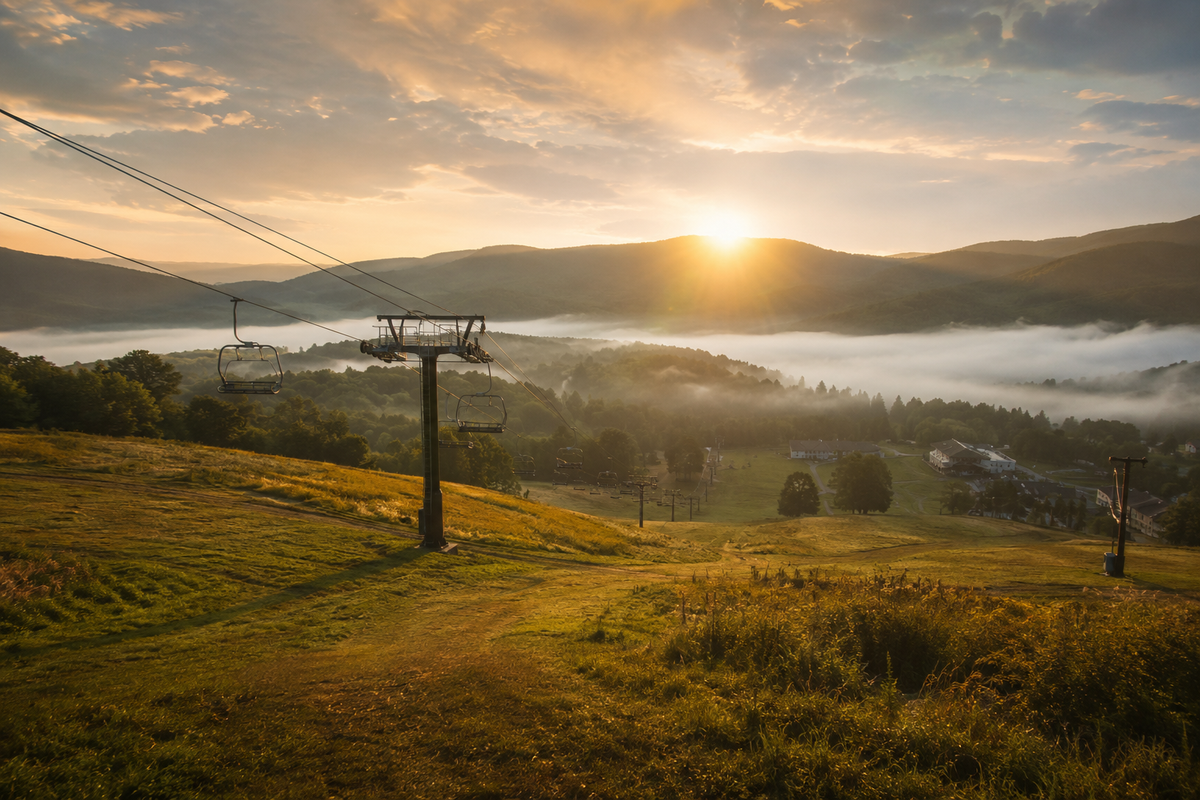
What I can tell you is this: I recently visited a place that called itself a ski resort but was really something else entirely. Something harder to define. It had skiing, yes. It had golf. It had the kind of amenities that make you slow your pace and look around and think — who built this, and how did they get it so right?
But what hit me hardest wasn’t the infrastructure. It wasn’t the lifts or the fairways or the spa or the restaurant with the view that makes you forget what you were saying mid-sentence.
It was the feeling of the place.
It was a community.
Community Isn’t a Feature. It’s a Foundation.
We throw that word around a lot in real estate. “Community.” It shows up in every brochure, every offering memo, every pitch deck. But most of the time, it’s a marketing word dressed up as a value proposition.
The real thing — the actual lived version of community — is something different. You know it the moment you feel it. It’s organic. It’s unscripted. It’s people who genuinely know each other, look out for each other, share a mountain or a green or a dining room and actually care about the place they’re in.
You cannot manufacture that overnight. You cannot brand it into existence. You cannot engineer it with amenities alone.
This trip reminded me of that. And it sent my mind straight back to home.
My Home Mountain
I’m a Sunday River guy. Have been for years.
If you know, you know. If you don’t — go. But go in the right season, with the right people, and give it enough time to get under your skin.
What I love most about Sunday River isn’t the terrain, though the terrain is great. It’s not the snowmaking, though nobody does it better in the East. It’s the people who come back year after year. The families who’ve been skiing the same runs for two generations. The kids who learned to ski there and now teach their own kids. The bartenders and ski patrollers and lift operators who actually recognize you.
That kind of community doesn’t happen because someone decided it should. It happens because the conditions were right — and because people cared enough to protect it.
That’s the part that keeps me up at night as a developer.
The Threat No One Likes to Talk About
Here’s the uncomfortable truth about ski communities: they’re fragile.
Not because people don’t love them. They do — deeply. But love alone doesn’t keep a community alive. Economics do. Access does. Affordability does.
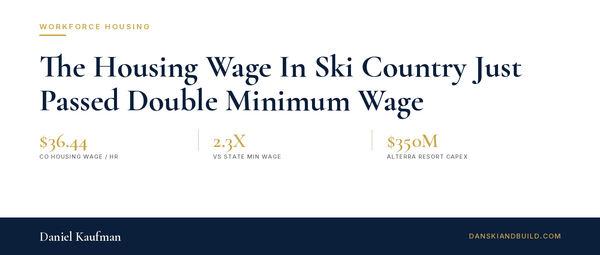
When the workforce can’t afford to live within an hour of the mountain — the instructors, the lift operators, the hotel housekeepers, the restaurant staff — the whole ecosystem starts to crack. Service quality drops. Institutional knowledge walks out the door. The seasonal employees who gave a place its soul stop coming back because they literally cannot afford to.
And when the “missing middle” — teachers, young families, local business owners, the people who make a mountain town feel like a town — get priced out of the housing market, you don’t just lose residents. You lose the connective tissue of community itself.
I’ve seen it happen. I’ve watched ski towns hollow out from the inside while lift tickets got more expensive and base lodge renovations got fancier. The mountain looked better. The community felt worse.
What Good Stewardship Actually Looks Like
The place I visited recently got something right that most don’t: they thought about the whole ecosystem, not just the high end of it.
As developers, investors, and operators in ski country — and in resort communities more broadly — we have a responsibility that goes beyond ROI. We are, whether we like it or not, in the community-building business. The decisions we make about what to build, who to build it for, and at what price point shape the character of a place for decades.
That means:
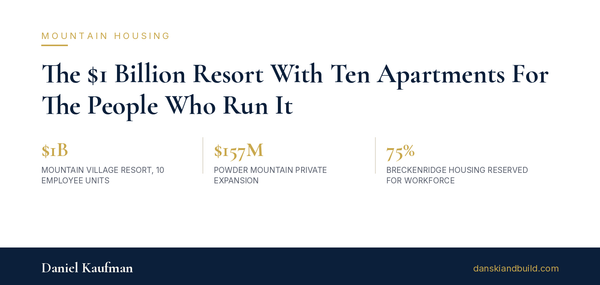
Building workforce housing. Real workforce housing — not as a checkbox, not as a concession to a planning board, but as a genuine part of the plan. The people who make these places run deserve to live in them.
Building for the missing middle. Year-round homeowners. Young families. Local professionals. These are the people who anchor a community through the off-season, who vote in local elections, who coach little league and sit on planning boards and keep the fabric of a place from unraveling.
Listening to the community. This one sounds obvious. It rarely is. Real listening means going to the meetings, reading the comments, sitting across the table from people who’ve been there longer than you and actually hearing what they have to say — even when it’s inconvenient.
Building sustainably. Not just environmentally (though that too), but economically. A community that can only exist if everyone is wealthy is not a community. It’s a resort. There’s a difference, and it matters.
Why I’m Thinking About All of This
Because I’m an operator and a developer who loves skiing. Because I spend time at mountains not just as a visitor but as someone who thinks about what makes places work. Because the line between where I ski and what I build has always been blurry for me — and I think that’s a good thing.
The best ski communities I’ve ever been part of weren’t created by a master plan. They grew from the ground up, shaped by people who cared, protected by stewards who took the long view, and sustained by the kind of diversity — economic, generational, occupational — that makes a place feel alive in February and July.
That’s what I want to build. That’s what I want to protect.
More on where I visited, and why it matters, in a future post.
Until then — get out there. And when you do, look around. The mountain is just the backdrop. The people are the point.
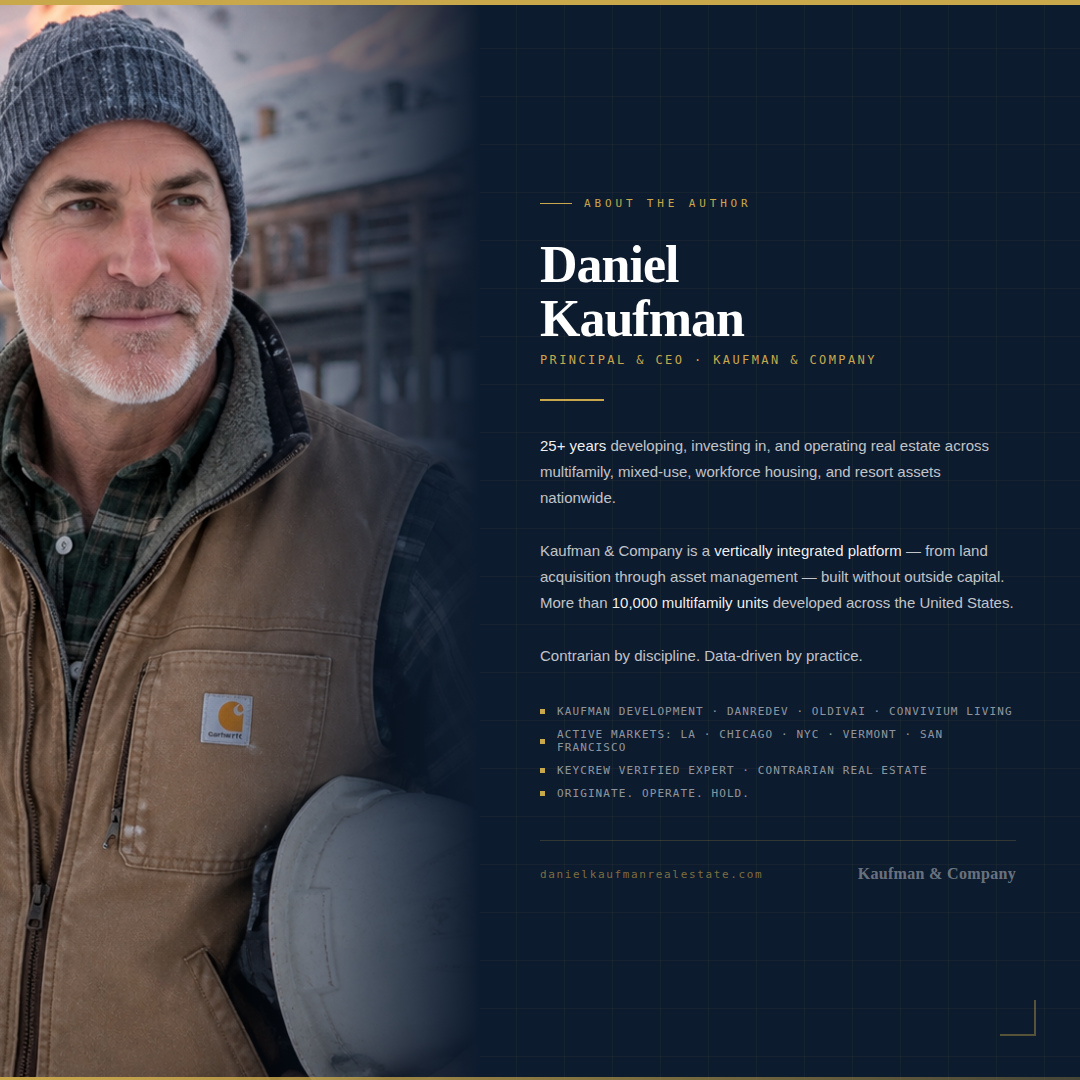
Daniel Kaufman is the founder of Kaufman & Company and a real estate developer with 25+ years of experience in multifamily, workforce housing, resort, and hospitality development. He writes about skiing, building, and the places where those two worlds meet at danskiandbuild.com.