Vail Just Admitted the Epic Pass Growth Story Is Over
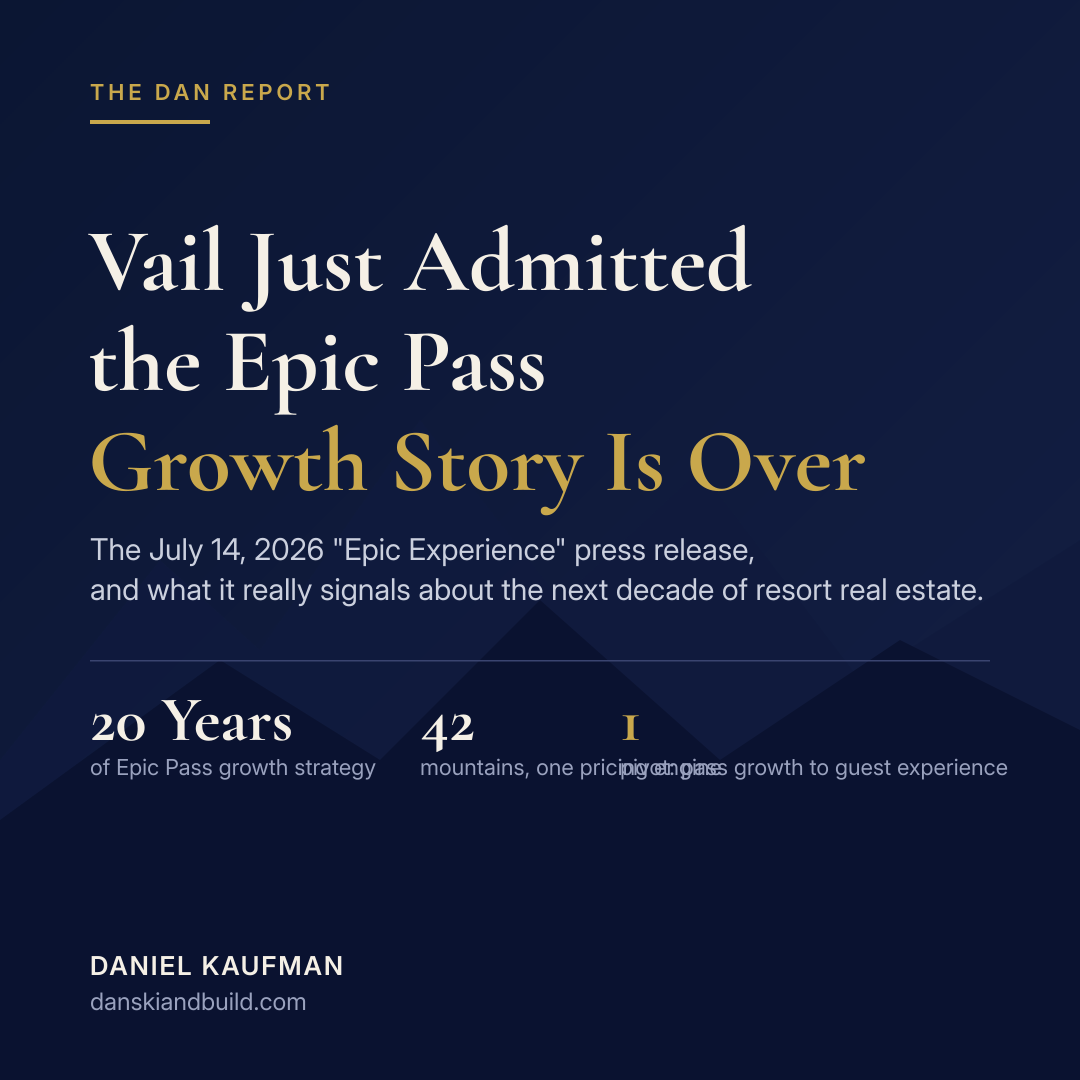
For most of the past twenty years, Vail’s playbook was simple. Buy resorts, put them on the Epic Pass, and use the pass’s ever increasing value to get skiers to commit their money before the snow even falls. It worked. It made Vail the largest ski resort operator in the world and it rewrote how lift access gets sold across the entire industry.
On July 14, 2026, Vail put out a press release built around a new phrase, “Epic Experience.” Read closely, it is close to a confirmation that the growth strategy has run its course.
What changed
The subscription model was never really about skiing. It was about locking in revenue before the season started, the way a gym locks in members every January. For a long time that worked because the pass kept getting more valuable relative to a day ticket, so more people bought in earlier, and Vail could plan capital and staffing against known volume.
That flywheel needs one thing to keep spinning, and it is new pass buyers every year. Once a company has already signed up most of the serious skiers in North America, the only way to keep growing pass revenue is to raise prices on the people already locked in, which is a different business than the one that built the company.
The Epic Experience press release reads like a company that has hit that wall. Instead of leading with pass growth numbers, the way Vail has for two decades, the messaging shifted toward guest experience, staffing, and operations. That is not a small pivot. It is an admission that the next phase of value creation is not going to come from adding more names to the pass list, it is going to come from making the experience good enough that the people already on the pass keep renewing.
The part that should get more attention
Here is the piece I do not think gets discussed enough when people talk about “guest experience.” You cannot buy your way into better guest experience the way you can buy your way into a bigger pass network. Guest experience is delivered by people. Lift operators, ski patrol, food service, hotel staff, the person who grooms the run at four in the morning. And every mountain town chasing that experience upgrade is running into the same wall I have been writing about for two years now, which is that there is nowhere for those workers to live.
You can announce all the operational investment you want. If your lift operator is commuting ninety minutes each way because the town priced out anyone making resort wages, or sleeping four to a room in workforce housing that should have been built a decade ago, the experience does not improve. It gets worse, because turnover goes up and the people who stay are stretched thinner covering the gaps.
This is exactly the gap Oldivai was built to close. Employer anchored workforce housing, built for the 80 to 120% AMI band that resort towns consistently fail to serve, is not a nice to have next to an experience pivot like this. It is the infrastructure the pivot depends on. A resort operator can rebrand around guest experience all it wants, but without housing for the staff delivering that experience, the strategy is a press release, not a plan.
What I take from this
Vail spent twenty years proving that scale and subscription pricing could reshape an entire industry. That story is not wrong, and it was genuinely transformative. But scale was always going to run into a ceiling, and July 14 looks like the day Vail told the market it found it. What comes next will not be won by whoever has the biggest pass network. It will be won by whoever actually solves the staffing and housing problem underneath the experience they are promising to deliver.
That is the part of this story I am watching most closely, and it is the part most of the coverage is going to miss.
About the Author
Daniel writes danskiandbuild.com, where he covers the ski and mountain resort industry from an operator’s seat, connecting resort economics to the workforce housing gap that shapes which communities actually work.