The $1 Billion Resort With Ten Apartments For The People Who Run It
Private capital is pouring hundreds of millions into ski country real estate. Workforce housing is still an afterthought, and Breckenridge is the exception that proves it.

Private capital is pouring hundreds of millions into ski country real estate. Workforce housing is still an afterthought, and Breckenridge is the exception that proves it.
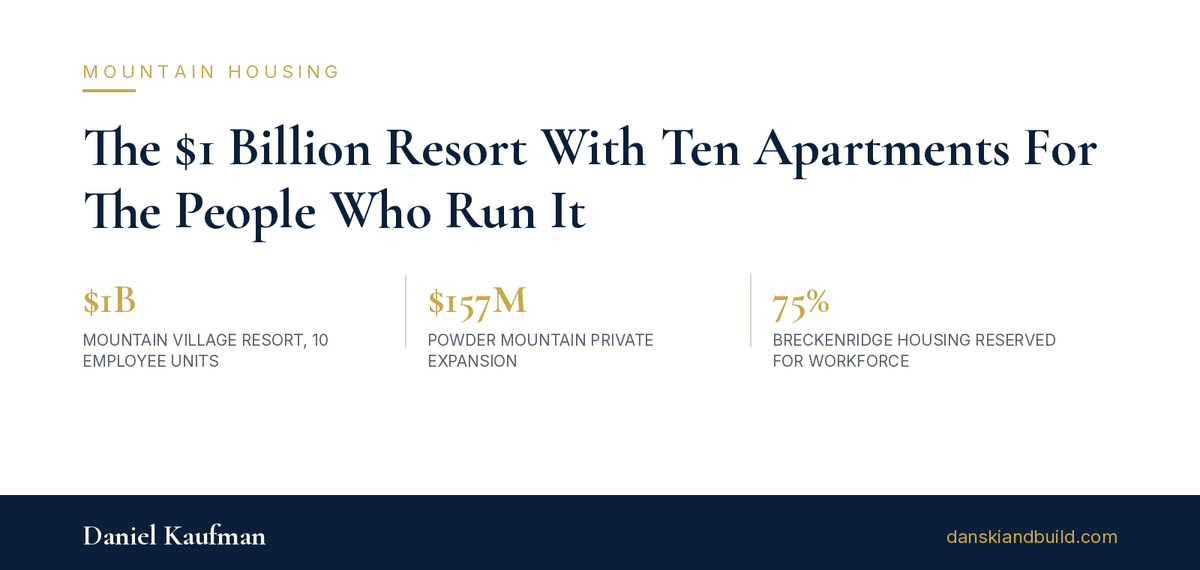
Mountain Village, Colorado just landed a $1 billion resort project anchored by a new Four Seasons. The development includes 26 private residences priced between $4 million and $35 million each, backed by a $417 million construction loan from JPMorgan. Buried in the plans: 10 apartments for the employees who will actually run the place.
That ratio is not an outlier. It is close to the industry standard right now.
Two hundred miles northwest, Powder Mountain in Utah is moving through a $157 million private expansion backed in part by Reed Hastings, the former Netflix CEO. The project, branded Powder Haven, is adding terrain, lodging, and amenities. I have not seen workforce housing broken out as a line item in what has been reported so far, and given the pattern across the industry, I would not assume it is a priority.
I understand the math from the developer's side. A $4 million residence pencils. A one bedroom apartment for a lift operator does not, not on the same land, not against the same return targets. So when private capital moves into a resort town, it moves toward the units that carry the highest revenue per square foot, and workforce housing gets treated as a mitigation requirement to satisfy rather than a piece of the investment thesis.
The problem is that resorts cannot run without the workforce. Lift operators, ski patrol, restaurant staff, housekeeping, the people who make a $1 billion resort functional on any given Tuesday. When there is nowhere for them to live within a reasonable commute, operators end up leasing block after block of hotel rooms for the season or scrambling to rent whatever cabins are left, and the cost of that instability shows up eventually in service, in staffing, in turnover.
Breckenridge is the exception worth studying. The town has deed restricted roughly 1,700 of its 2,300 full time housing units for the local workforce, which is around 75 percent of that stock. That did not happen by accident. The town has committed more than $13 million a year to housing programs and has built over 400 workforce units since 2022. And it still is not enough. Town officials estimate they need roughly 1,200 more units to keep pace, even after all of that investment, because the average home listing in Breckenridge is now around $1.85 million, up about 80 percent over the past decade.
I keep coming back to this because it is the clearest evidence I have seen that workforce housing has to be underwritten deliberately. It does not show up as a byproduct of luxury development, and it does not show up through the market correcting itself. Breckenridge built it because the town treated it as core infrastructure, funded it consistently, and kept building even when the math was hard, and even they are behind.
This is exactly the gap I am building toward with Oldivai. Resort towns are proving out $1 billion in demand for ski country real estate. Almost none of that capital is underwriting the housing that keeps the resort running. I think that gap is the opportunity, and I think it is going to get more expensive to ignore every year that it is not addressed.
If you are working on workforce housing in a resort market, whether you are a developer, a town planner, or an operator trying to solve this for your own staff, I would like to hear what you are seeing. Reach out.
Daniel Kaufman is a real estate developer and investor focused on workforce and attainable housing, including in mountain and resort communities. He writes about the gap between where capital is flowing and where housing is actually needed.
Reach me at Daniel@kaufmanredev.com or find more at danielkaufmanre.com.