Comeback Country: The Case for Buying a Dead Ski Hill

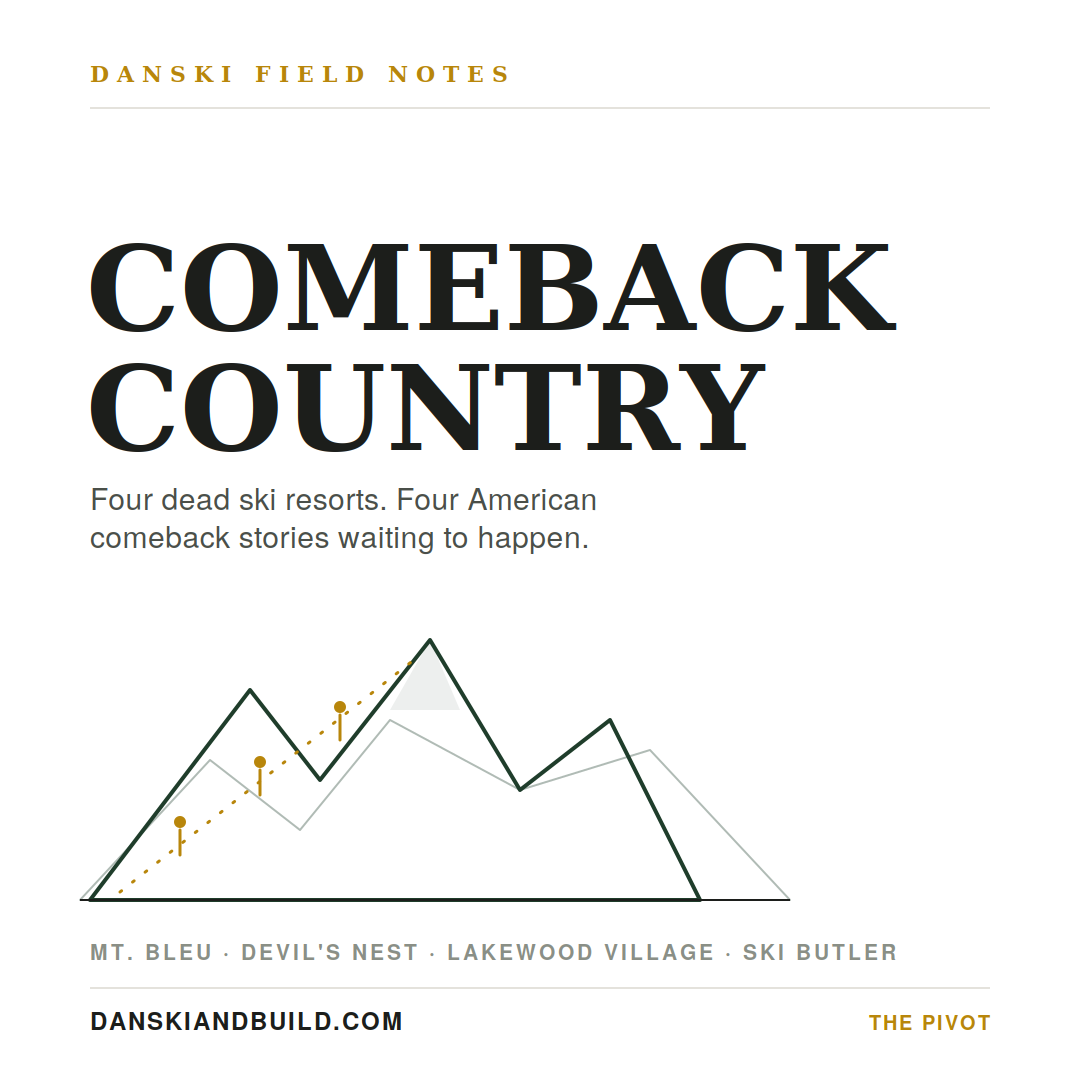
I read a piece this week on Snowbrains about the four states that used to have ski resorts and don’t anymore. Kansas lost Mt. Bleu in 1983. Nebraska lost Devil’s Nest in 1974. Kentucky lost both Lakewood Village and Ski Butler by the mid 1980s. Georgia lost its synthetic slope at Vinings Ridge when the novelty wore off. The article treats these as a kind of ghost story, abandoned lift towers, rusted snow guns, a golf course sitting where a rope tow used to run.
I read it differently. I read it as a deal list.
Every one of these properties failed for a reason that made sense forty or fifty years ago and makes a lot less sense today. Underpowered snowmaking. Thin capitalization. Ownership that couldn’t survive two bad winters in a row. Those are fixable problems now in a way they weren’t in 1974. The terrain didn’t go anywhere. The proximity to metro populations didn’t go anywhere. What changed is that the industry consolidated hard into a handful of mega pass networks, and in doing that, it left a lot of regional terrain on the table that never fit the portfolio model in the first place.
That’s the opportunity. Not nostalgia for what these places were, but a clear eyed look at what they could be with real capital and modern equipment behind them.
The pick: Devil’s Nest, Nebraska
If I had to put my own money on one of these four, it’s Devil’s Nest.
Here’s why. It already has a second life story starting, new interest in the land for residential lots, cabins, trails, a potential marina. Somebody with capital is already circling this property for exactly the reasons I’d circle it. The original 1970s plan was actually the right instinct at the wrong scale and the wrong balance sheet, a year round resort combining skiing, an equestrian center, and housing. That developer just couldn’t afford the property taxes long enough to get there. Bankrupt by 1974, foreclosed, sold at auction in 1977.
Run that same concept through a modern development model and it looks completely different. You are not building a ski hill and hoping people show up. You are building workforce and second home housing anchored around a four season recreation amenity, with skiing as one piece of a broader draw that includes the horseback riding and trail use already gaining traction there. That is a model I know well from the mountain resort work we do at Kaufman and Company. Recreation draws rooftops. Rooftops fund the amenity. The amenity was never the whole business, it was always the anchor for the real estate play around it.
Why the other three still interest me
Mt. Bleu in Kansas has real proximity going for it, close to Lawrence and within range of the Kansas City metro, and its original failure was mostly about pulling water from the Wakarusa River for snowmaking rather than running real snowmaking infrastructure. That is a solvable engineering problem today, not a fatal flaw.
Lakewood Village and Ski Butler in Kentucky both died the same death, humid climate that couldn’t hold natural snow and no snowmaking system built to compensate for it. Modern snowmaking technology handles marginal climates far better than anything available in 1980. Kentucky also has a built in advantage the others don’t, it sits inside a day drive of several dense metro populations that currently have no local ski option at all.
Vinings Ridge in Georgia is the outlier because it was never snow in the first place, a synthetic surface built for a market that couldn’t support the maintenance cost once the novelty faded. I’d leave that one alone. The other three had real snow and real terrain working against a capital problem. That’s a very different starting point.
The broader thesis
The mega pass era consolidated the ski business into a small number of national operators, and that consolidation strategy worked well for the resorts that made the cut. But it also created a gap. Regional terrain, close to population centers, without the balance sheet or the visitation base to interest a national operator, got left behind. That gap is exactly where a properly capitalized independent operator can build something a national pass network never would, a resort designed around its local market instead of a nationwide one.
These four states aren’t a list of failures. They’re a list of properties nobody has correctly financed yet. Give me modern snowmaking, a housing component to anchor the economics, and patient capital that can survive a bad winter, and any one of these becomes a very different story the second time around.
Which one would you bet on.
Daniel Kaufman has spent more than 25 years building, lending, and investing in housing markets across the country, starting out in Detroit back in 1992. These days a lot of his attention is on workforce housing and mountain resort communities, the kind of projects he writes about here under the name Danski. He is always glad to hear from readers.
Email: Daniel@kaufmanredev.com
Phone: 341 217 2580
LinkedIn: linkedin.com/in/danielekaufman
Web: danielkaufmanre.com