Snow in August: Inside the All-Weather Snowmaking Boom Reshaping New England Skiing

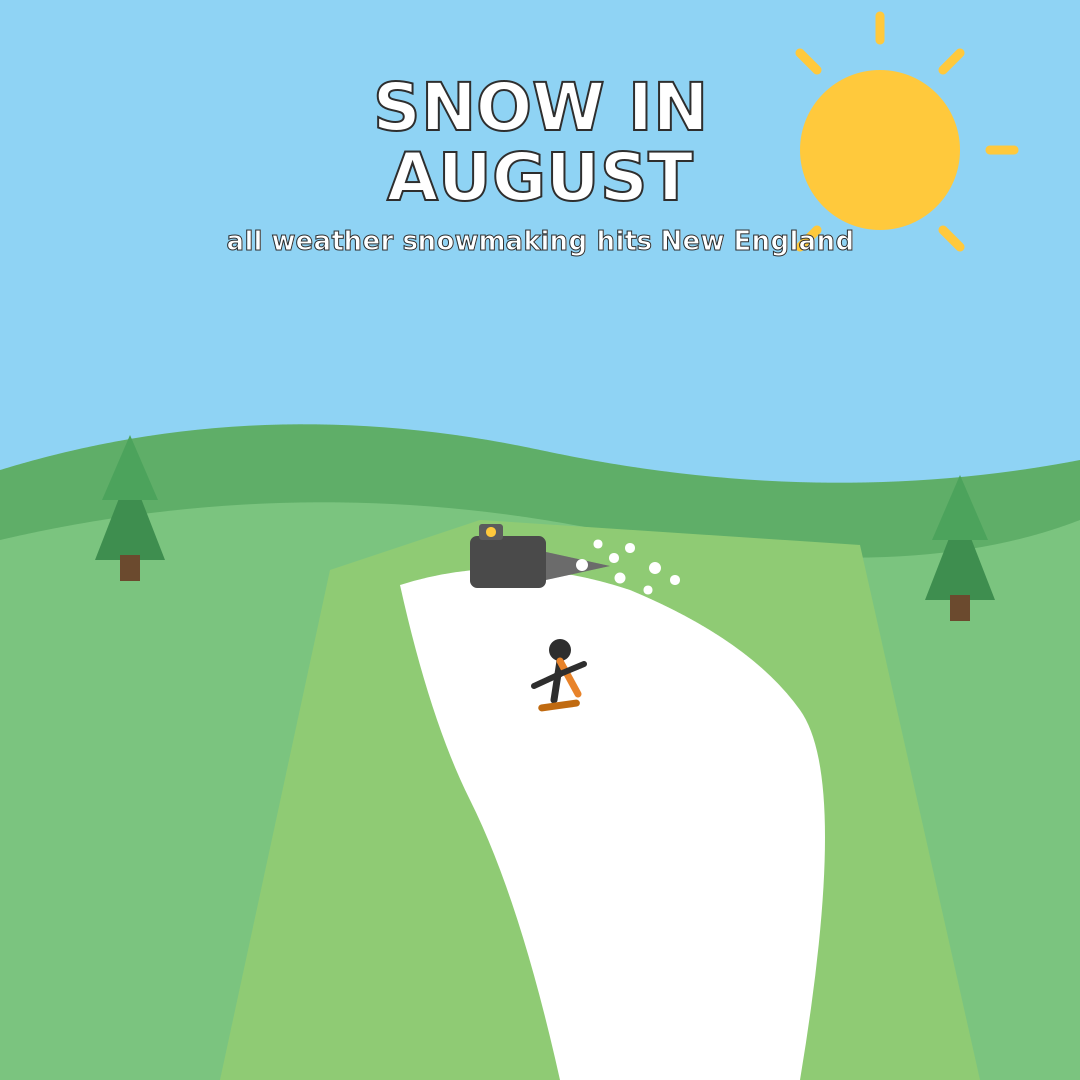
Last week, a Connecticut ski area made snow to Dolly Parton. That sentence alone tells you something has changed.
Mount Southington announced it has acquired a new TechnoAlpin SnowFactory, a machine that manufactures snow regardless of what the thermometer says outside, and marked the occasion by blowing snow across the base area in the middle of an 80 degree August afternoon, Dolly Parton playing over the speakers the whole time. It reads like a stunt. It isn't really one. It's the latest, most visible sign of a real shift in how ski areas, especially small ones with thin margins for error, are hedging against an increasingly unreliable winter.
What Mount Southington Just Did
The SnowFactory isn't Mount Southington's only recent investment. Over the past year the Central Connecticut area has also added new low energy snowguns, expanded its Glacier learning area, brought in a new 2026 Prinoth Bison X groomer, and refreshed its rental fleet with Volkl skis. Taken together, it's a pattern of ownership putting real money into a 14 trail, 8 lift hill with a 425 foot vertical drop, modest by Western standards, but one of Connecticut's most active operating ski areas, with 100% snowmaking coverage, night skiing, and an offseason calendar that already includes summer camps, volleyball, cornhole, and events. The SnowFactory extends that offseason identity into something new, a ski area that can credibly make snow in any month of the year.
Not the First, and Not Alone
Mount Southington's announcement landed just days after Sky Tavern, a nonprofit learn to ski area outside Reno, Nevada, used its own SnowFactory to throw a full blown on snow party on August 22, complete with a snowman building contest, sledding, an obstacle course, a bike ride, a BBQ, a live DJ, and a cameo from freestyle skiing pioneer Wayne Wong, who stopped by to see snow in the middle of a Nevada summer. By the account of the outlet that covered it, Sky Tavern's unit was one of only six SnowFactory machines installed at ski areas anywhere on the planet at the time. Two of the six now belong to small, community oriented hills three time zones apart, both using the same idea, an on snow event in August, to make the point.
Southington and Sky Tavern are the newest entrants to a trend that's been building in Southern New England specifically for a few years now. Powder Ridge, in Middlefield, Connecticut, installed a DemaClenko SnowPro system that can produce snow up to roughly 60°F, part of an operation the resort bills as one of the largest snowmaking setups in North America, and the payoff has been a guaranteed Black Friday opening and the ability to host early season events well before natural cold arrives. Ski Ward, in Shrewsbury, Massachusetts, has run a Latitude90 L60 system for several seasons and has used it to claim the "first lift served skiing in North America" title in three of the last four seasons, opening as early as mid to late October on a 45 acre hill with a magic carpet and a single strip of machine made snow. Mount Southington now joins them with TechnoAlpin, following Sky Tavern's lead out west.
How These Machines Actually Work
It's worth being precise about what makes these different from the snowguns a ski area already runs every winter. Traditional snowmaking atomizes water into the air and relies on cold, dry ambient conditions, usually the mid 20s°F or colder on the wet bulb scale, to freeze the droplets before they hit the ground. That's why snowmaking season has always started in November or December, whenever the first real cold snap arrives, and why a warm stretch can shut a snowmaking operation down entirely.
Machines like the TechnoAlpin SnowFactory, the DemaClenko SnowPro, and the Latitude90 units don't wait for cold air. They're self contained refrigeration plants, TechnoAlpin's version arrives on site inside a 40 foot shipping container, that chill water to freezing using an internal heat exchanger, crystallize it into actual snow inside the unit, and push the finished product out onto the slope, all independent of the outside temperature. TechnoAlpin says its system works in outdoor temperatures up to 95°F, and, notably, uses far less water than a conventional snowgun, roughly 60 to 80 liters a minute compared with 450 plus liters a minute for traditional equipment. The tradeoff is that instead of leaning on free cold air, these units are running active mechanical refrigeration to make every pound of snow, which is a meaningfully more energy intensive way to do it.
Why This Is Happening Now
The honest answer is that the traditional snowmaking window is getting less dependable, and small Northeast and Mid Atlantic hills feel that first and worst. Vail Resorts reported roughly a 20% visitor decline in the 2025 to 2026 season compared with the year before, and researchers estimate shortened, more volatile seasons already cost the ski industry on the order of $250 million a year in the U.S., a figure that could climb toward $1.35 billion annually by the 2050s under higher emissions scenarios, with seasons projected to run anywhere from two to nine weeks shorter than they were in the 1960s and 70s.
Forecasters are also watching a strong, or "Super," El Niño pattern build for winter 2026 to 2027, with roughly 97% confidence it persists into early spring 2027. That's genuinely good news for snowpack in California and the Southwest, but it comes with a catch that matters more for a place like Connecticut or Massachusetts than for the Rockies. El Niño winters tend to run warmer overall, which pushes the rain and snow line higher and can mean more precipitation falls as rain rather than snow at lower elevations, exactly the elevation band Southington, Powder Ridge, and Ski Ward operate in. All weather snowmaking isn't really a bet on any specific forecast, it's insurance against the growing number of scenarios where natural cold and conventional snowmaking both fail to show up on schedule.
There's also a competitive angle that shouldn't be overlooked. Ski Ward's multi year run as North America's first area to open has turned a 45 acre hill into a name recognized well outside Massachusetts, purely on the strength of an October opening date. For small operators without a marquee vertical drop or terrain to sell, being first, or hosting the first snow party of the summer, has become a legitimate marketing asset. All weather snowmaking is as much a media strategy as it is an operations one.
The Catch, Is This Actually Sustainable?
It would be incomplete to frame this purely as a win. Snowmaking already accounts for something like 18% of the average ski resort's total energy use, and there's a genuine, unresolved debate among researchers about whether pouring more energy into artificial snow production is real climate adaptation or a kind of maladaptation, using an energy intensive fix to treat a problem that burning more energy helped cause in the first place.
The water side of the ledger looks better for these specific machines, TechnoAlpin's efficiency numbers suggest the SnowFactory uses a fraction of the water a conventional snowgun does. But water efficiency and energy efficiency aren't the same thing, and running mechanical refrigeration around the clock in August heat is inherently a bigger electrical draw than pointing a gun into naturally cold, dry December air. Ski areas adopting this technology are trading one resource constraint for another, not eliminating the tradeoff.
What to Watch
Six SnowFactory units worldwide is a small number, but it won't stay small, not with two of them now generating this much attention from a single announcement each. Expect more Northeast and Mid Atlantic areas at Southington's scale to follow, especially operators who've already watched Ski Ward turn an October opening into a national headline. Expect more of these installations to be unveiled with an event rather than a press release, since an on snow party sells the technology better than a spec sheet does. And expect the industry's honest reckoning with the energy question to keep pace with the marketing, because the ski areas most likely to need this technology are exactly the ones with the thinnest budgets to absorb a bigger power bill.
For now, though, the story is simpler than all that. It's late August, and there's snow on the ground in Connecticut. Whatever comes next, that's a genuinely new thing for a ski area like Mount Southington to be able to say.
Sources: Unofficial Networks, Connecticut Ski Area Makes Snow In August; Unofficial Networks, Sky Tavern all weather snowmaking; Adventure Sports Network, Summer Snow Day at Sky Tavern; NBC Connecticut, New snowmaking technology installed at Powder Ridge; Unofficial Networks, Ski Ward 2025 26 season; Boston.com, Ski Ward first to open; TechnoAlpin SnowFactory; SnowBrains, El Niño 2026 27 Ski Forecast; Marketplace, Ski resorts snowmaking climate change.