The Seasonal Squeeze: What Vermont’s Housing Data Tells Us About Every Ski Town in America

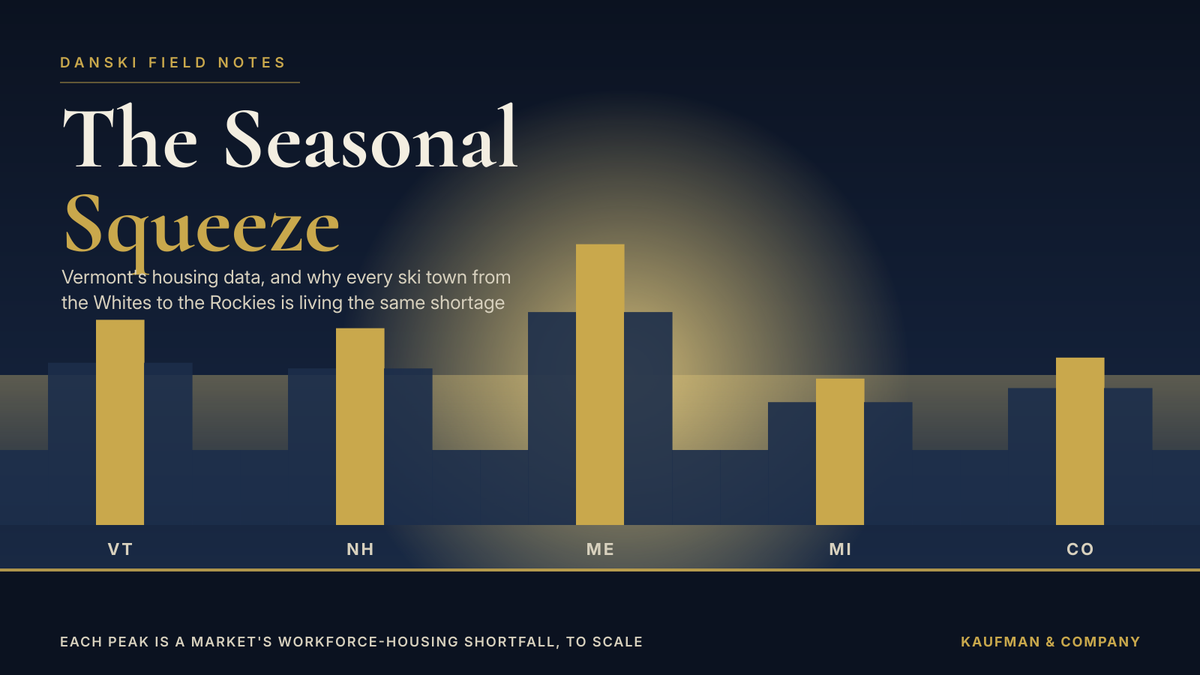
Vermont Housing Finance Agency just published its 2025 to 2029 Housing Needs Assessment, and if you operate, invest, or lend anywhere near a mountain resort, you need to read the housing stock numbers closely. I’ve spent 25 years building and lending in these markets, and the Vermont data is the clearest statistical picture I’ve seen of a pattern I watch play out from North Conway to Steamboat every single season. I’m calling it the Seasonal Squeeze, and it’s the single biggest constraint on ski resort operations in this country right now, more than lift capacity, more than snowmaking, more than labor costs themselves.
The Vermont Numbers
Vermont has an estimated 335,061 homes. Of those, 196,446 are owner occupied (59%), 76,262 are renter occupied (23%), and 51,474, or 15%, are classified as seasonal or vacation homes. That 15% seasonal share is the second highest rate of any state in the country, behind only Maine, with New Hampshire close behind at third. Since 1960, seasonal homes have never dropped below 10% of Vermont’s total housing stock.
Here’s the part that should get every mountain town planner’s attention. Vermont’s occupied housing stock grew by just 0.6% per year from 2010 to 2020, adding roughly 1,200 homes annually. Compare that to the 1980s, when the state added around 3,200 homes a year, a 2% annual growth rate. The state permitted only 2,302 new homes in 2022, its best year in a decade, but still well below the 5,000 to 7,000 homes needed annually just to keep pace. VHFA projects Vermont needs 24,000 to 36,000 additional homes statewide between 2025 and 2029 to house new households, replace deteriorating stock, normalize vacancy rates, and address homelessness.
Construction costs are the other half of the story. They’ve risen at a 30% annual pace since the start of the pandemic. The average cost of building a single low-income apartment unit within a multifamily building hit roughly $500,000 in 2023. The median newly constructed single family home in Vermont sold for $616,500 that same year. When it costs that much to build, workforce housing simply doesn’t pencil without some form of subsidy, land donation, or below market capital, which is exactly why I keep underwriting these deals with public private structures rather than pure market rate assumptions.
And then there’s the short term rental effect. More than 11,000 Vermont homes, about 4% of the entire housing stock, were actively used as short term rentals for at least one night in September 2023 alone. The towns of Stowe, Killington, Ludlow, Dover, and Warren, the state’s premier ski destinations, consistently carry the highest concentration of both seasonal homes and short term rental listings. Every bed that goes into the nightly rental pool is a bed that comes out of the workforce housing pool. That trade off is not theoretical, it shows up directly in Vermont’s data, and it shows up in every resort market I’ve operated in.
North Conway, New Hampshire: The Same Story, Different County Line
Drop south into Carroll County, New Hampshire, home to North Conway and Cranmore Mountain, and you find the identical dynamic. Conway’s own 2024 Master Plan identifies a 2.3% rental vacancy rate and reports that 51% of renters in town are cost burdened. Local officials have described vacancy in Conway proper at under 1%, tight enough that restaurants and retailers have had to cut operating hours simply because they cannot staff shifts. The town has been embroiled in litigation over its short term rental ordinance, because STRs have pulled units that once housed seasonal lift operators and servers into the nightly vacation rental market instead.
Statewide, New Hampshire has added 25,688 housing units since 2020, about 78.5% of the 32,704 units its own 2023 needs assessment said were required by 2025. The state needs 88,364 total units by 2040 to reach a balanced market. Meanwhile the median single family home price in New Hampshire hit a record $535,000 in 2025, up 122% over the past decade. Builders in Conway, per the town’s own planning commentary, have defaulted to high end construction “for years,” to the exclusion of workforce product, which is the exact same capital allocation problem I see everywhere seasonal demand outcompetes local wages for the same dirt.
Bethel, Maine and Sunday River: Second Homes Outnumbering Year Round Homes
Bethel is maybe the starkest example I’ve found anywhere. Roughly nine out of every ten houses in Bethel are second homes. The town had somewhere between 302 and over 500 active short term rental listings tracked in a single season, with average daily rates around $396, among the highest of any comparable Maine vacation market. Sunday River Resort employs about 1,500 people in winter and 600 in summer, and the resort has had to rent out 116 hotel rooms just to house its own staff because there is nowhere else for them to live.
The permitting data tells the capital allocation story even more clearly. Newry, the town where Sunday River sits, issued 23 new housing permits in 2025, but on a per capita basis that works out to roughly 54 permits per 1,000 residents, nearly ten times the statewide average of about 5.5. New construction is happening in Newry, it’s just not workforce construction, it’s second home and short term rental product chasing resort demand. Maine needs 84,000 new housing units statewide by 2030, and only 13% of the permits issued in 2025 were for affordable housing, concentrated almost entirely in southern Maine, nowhere near the mountain communities that need it most.
Michigan’s Ski Country: A Quieter Version of the Same Squeeze
Northern Michigan doesn’t get the second home pressure of New England or Colorado in quite the same proportions, but the labor and housing math still breaks the same way. At this year’s Northern Lakes Economic Alliance summit, held at Boyne Mountain Resort itself, roughly 340 regional business and community leaders identified the same three bottlenecks over and over, workforce shortages, housing shortages, and childcare access. Boyne Resorts, headquartered in Boyne Falls and now employing more than 10,500 full time and seasonal staff across its properties, has acknowledged housing constraints as it continues to expand. Crystal Mountain, the other major Michigan ski operator, is explicit on its own careers page that permanent year round or seasonal employee housing simply is not available, only limited dormitory style options depending on capacity. That is a resort operator telling its own future workforce, in writing, that housing is not part of the deal. In a labor market this tight, that is a real competitive disadvantage against resorts that have solved for it.
Steamboat Springs, Colorado: Where I’ve Been Spending time this Summer
I’ll close where I’ve actually been visiting and building this summer, because Steamboat puts numbers on everything I’ve described above and then some. Routt County’s 2025 housing study identified a shortage of roughly 3,100 units relative to workforce demand. More than half of Routt County’s renter households are cost burdened. The median home price in Steamboat hit $1.3 million in 2025, while the area median income sits at $91,000, up 9.1% year over year but nowhere close to keeping pace. A typical two person household earning that median income can afford a home priced around $390,000. That leaves a gap of roughly $900,000 between what local workers earn and what local homes cost, and 70% of all home sales in the market now transact above 200% of area median income.
Steamboat’s own city planning process puts the forward need at 1,573 units just to catch up with existing demand, plus another 767 units to keep pace with growth over the next decade, for a total of 2,340 additional units, or about 230 units a year. The Yampa Valley Housing Authority has built 285 workforce units since 2017 and has been the primary institutional response, alongside projects like the 75 unit Anglers Four Hundred development. Average rent across the market runs about $2,375 a month, roughly 45% above the national average. A 2023 Young Professionals Network survey found that two thirds of respondents feared housing costs would eventually force them out of town, and Colorado Futures Center data shows 25 to 45 year olds are the fastest declining age group in Steamboat Springs today. That is a resort town hollowing out its own future workforce in real time, and it’s precisely the demographic and cost dynamic I’m underwriting against as we break ground on our own project here this summer.
The Pattern, and Why It Matters to How I Underwrite
Every one of these markets, Vermont, North Conway, Bethel, Michigan, Steamboat, tells the same three part story. Construction has not kept pace with population and second home demand for at least a decade. Short term rentals and seasonal home ownership are absorbing housing stock that would otherwise serve the year round workforce that actually runs these resorts. And market rate new construction costs have outrun what workforce wages can support, which means workforce housing simply does not get built without dedicated capital, land, or policy intervention aimed specifically at that gap.
That’s the thesis I bring to every mountain resort deal I underwrite now. The lift ticket sales and real estate appreciation get all the headlines, but the operator who solves the employee housing problem is the operator who can actually staff the mountain, keep the restaurants open past 2pm, and retain the people who make a resort town worth visiting in the first place. The data backs that up in every market I’ve looked at, and Vermont just gave us the cleanest dataset yet to prove it.
If you’re operating, developing, or investing near a mountain resort and this data matches what you’re seeing on the ground, I’d like to hear about it. I write about these markets because I’m in them, building workforce and resort housing from Vermont to Steamboat Springs, and the best insights I get come from other operators comparing notes. Reach me at Daniel@kaufmanredev.com, or find more of this work at www.danielkaufmanre.com and www.danskiandbuild.com. Follow along on Instagram @danskiandbuild for the ongoing series on ski towns, housing data, and what it actually takes to build in these markets.