The Mountain Is Tilting: Why Right Now Is the Moment to Rebuild American Skiing

There's a strange thing happening in skiing right now. On paper, the sport has never been bigger — record pass sales, billion-dollar valuations, glossy base villages stretching across the West. And yet anyone who's actually clicked into a binding this season can feel it: something is off. The lift lines are longer, the parking is worse, the lodges are pricier, the snow is thinner, and the locals who built these towns can't afford to live in them anymore.
Skiing is at a crossroads. And honestly? That's exactly where we want to be.
The Corporate Squeeze Is Finally Getting Called Out
In March, a federal antitrust class action landed on Vail Resorts and Alterra Mountain Company — the two companies that, between them, control Epic, Ikon, and most of the marquee destinations on the continent. The complaint argues that the duopoly has "foreclosed independent ski areas" and pushed window ticket prices to absurd places — $356 at Vail-owned mountains, $339 at Steamboat — to herd skiers into season passes they don't really want but can't reasonably refuse.
Whatever you think of the lawsuit's odds, the underlying complaint is real. A skier today often has two choices: pay one of two megacorps, or hunt for the rapidly shrinking number of mountains that have managed to stay independent. That's not a healthy market. It's not a healthy sport either.
The Climate Reality We Stopped Pretending About
This was a brutal winter. Colorado, Utah, Washington, Oregon, California, and Nevada spent stretches of the season at 15–65% of average snowpack. Resorts in Oregon and Colorado closed early. Ashland paused operations indefinitely in mid-January. Aspen's former sustainability director called 2026 "a catastrophic year."
The long-term math is uglier. From 2008 to 2017, the share of precipitation falling as snow declined about 3.5% per year. By 2050, U.S. resorts could see snow accumulation drop 20–30%. In Europe, a 2°C warming scenario puts roughly 53% of resorts at very high risk of low-snow seasons.
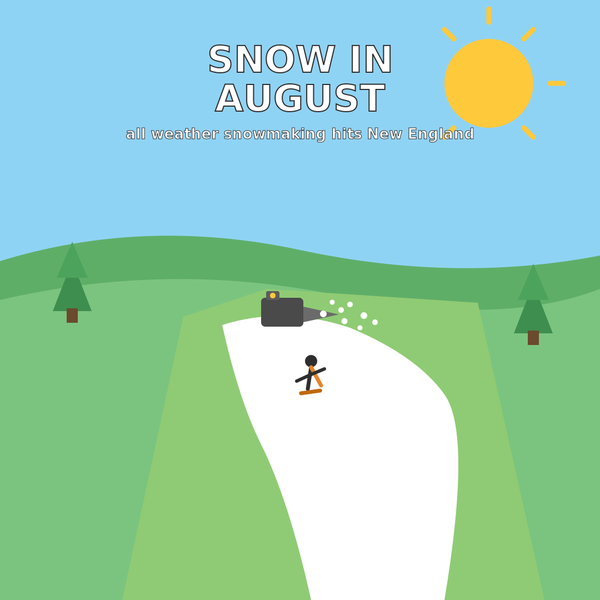
The industry has answered with snowmaking — machines now assist 89% of U.S. ski areas, up from 41% — but snowmaking is expensive, water-intensive, and politically fraught. It's a Band-Aid, not a strategy. Any plan for the next era of skiing has to start with a clear-eyed answer to one question: where will it actually still snow, reliably, in 2050?
The Hollowed-Out Ski Town
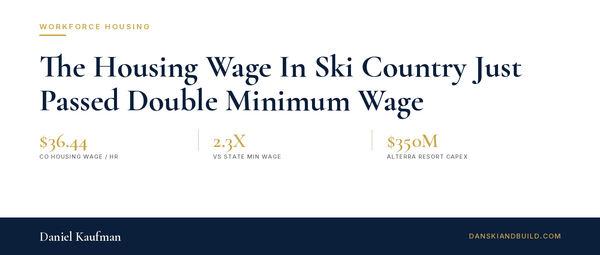
Walk through almost any mountain town in May 2026 and you'll see the same pattern: gorgeous houses, dark windows. The Colorado Association of Ski Towns estimates that in some communities, more than 40% of homes sit vacant for most of the year. Median rent in Steamboat hit $4,000/month. Workers in Winter Park, Jackson, Park City — they're commuting an hour each way, sleeping in cars, or leaving the industry entirely.
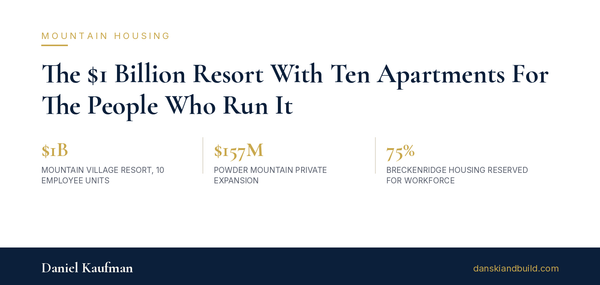
Some places are fighting back. Crested Butte committed to keeping 75% of its full-time housing for local workers. Jackson, Wyoming, has doubled its workforce housing since 2016. Breckenridge is buying market-rate homes and deed-restricting them on purpose, eating losses to keep the workforce nearby. Steamboat has been tearing itself apart over the Brown Ranch development.
This isn't a side issue. Without housing, you have no employees. Without employees, you have no resort. Any new project that doesn't put workforce housing in the first five slides of the deck is a project that's already failing.
Regulation Is Quietly Shifting
In March, the Forest Service finalized a new rule that scrapped the old "revenue test" for ski area permits. Now the agency evaluates resorts case-by-case — visitation, infrastructure, season length, investment — and explicitly acknowledges that many areas "rely more on revenue from non-skiing activities to stay solvent between years of greater snowfall."
Translation: the federal government has officially recognized that "ski resort" no longer just means "winter operation." Mountain biking, alpine coasters, weddings, music festivals, year-round lodging — the regulatory door is wider open than it's been in a generation. For anyone thinking about acquiring or building, that changes the math considerably.
Where the Wins Are Hiding
Here's the part nobody wants to admit: the most exciting things in skiing right now aren't happening at the megaresorts. They're happening at the small, weird, stubborn places.
Black Mountain in Jackson, NH was on the brink. Erik Mogensen — the guy behind Indy Pass and Entabeni Systems — bought it, dropped ticket prices, made it family-first, and turned it into what he openly calls an "Independent Mountain Laboratory" for testing software, lift hardware, and operational ideas to help small mountains punch above their weight. He just relocated his entire HQ from Colorado to a New Hampshire mountain town. Read that sentence again.
Bogus Basin runs as a 501(c)(3) nonprofit outside Boise, sustained by donations, low pass prices, and volunteers — and brings 2,000 schoolkids onto snow every season. Mad River Glen has been a successful skier-owned co-op since 1995. Cochran's in Vermont has been a family-run nonprofit for generations and has put more first-time skiers on the snow than most resorts ten times its size.
Meanwhile, more than 1,600 American ski areas have closed historically. Many of them still have lift towers standing, lodges intact, and snowmaking infrastructure rotting in place. Some are being reborn as mountain bike parks. Others are just waiting.
Acquire or Build From Scratch?
This is the question we keep coming back to.
Acquiring a dormant or struggling area is faster, cheaper per acre, and often comes with grandfathered permits, existing lift infrastructure, and an emotional community that wants the place to live again. The downsides: deferred maintenance can be brutal, snowmaking systems may be obsolete, and elevation/aspect/snowfall reliability are fixed — you bought what you bought.
Building from scratch lets you site for the next 50 years of climate, design housing into the master plan from day one, install efficient modern lifts, and integrate four-season revenue from the ground up. The downsides: permitting timelines that could outlive you, capital requirements that demand serious partners, and the risk of becoming exactly the kind of glossy, soulless development the market is sick of.
The honest answer is probably "both, in different markets, with different partners." The right move depends on geography, water rights, the local political climate, and — most of all — whether the surrounding community actually wants what you're building.
What We're Working On
At Dan Ski & Build, we've been heads-down on several plans that touch every piece of the puzzle above. Some involve acquisitions. Some are clean-sheet projects. All of them are designed around three non-negotiables: the workforce can afford to live in the town, the operation is built for the climate of 2050 and not 1995, and the soul of the place stays in the hands of people who actually ski there.
We're not ready to share locations yet — too many conversations are still in motion, and we want to do right by the communities involved before any of this hits the news. But we'll be revealing the first projects soon, and we're going to be loud about it when we do.
Now We Want to Hear From You
This is the part that matters most. We can read every market study and forest service rule on the planet, but the single most valuable input we can get is from skiers, snowboarders, lifties, ski patrollers, lodge cooks, second-home owners, locals, weekend warriors, and the parents trying to teach their kids to ski without taking out a second mortgage.
So tell us:
- What do you actually want from a ski area in 2030? Be specific.
- What do you miss from skiing 20 years ago that the megaresorts have killed?
- If you had a magic wand and could fix one thing about your home mountain, what would it be?
- Should we focus on reviving lost ski areas, or building something new from scratch?
- What's the single most underrated small ski hill in America right now, and why?
Drop your thoughts in the comments, send them to us directly through the site, or share this post with the skier in your life who has opinions. We're reading everything. The plans we announce later this year will be sharper because of it.
The mountain is tilting. Let's tilt it the right way.
— Daniel www.danskiandbuild.com
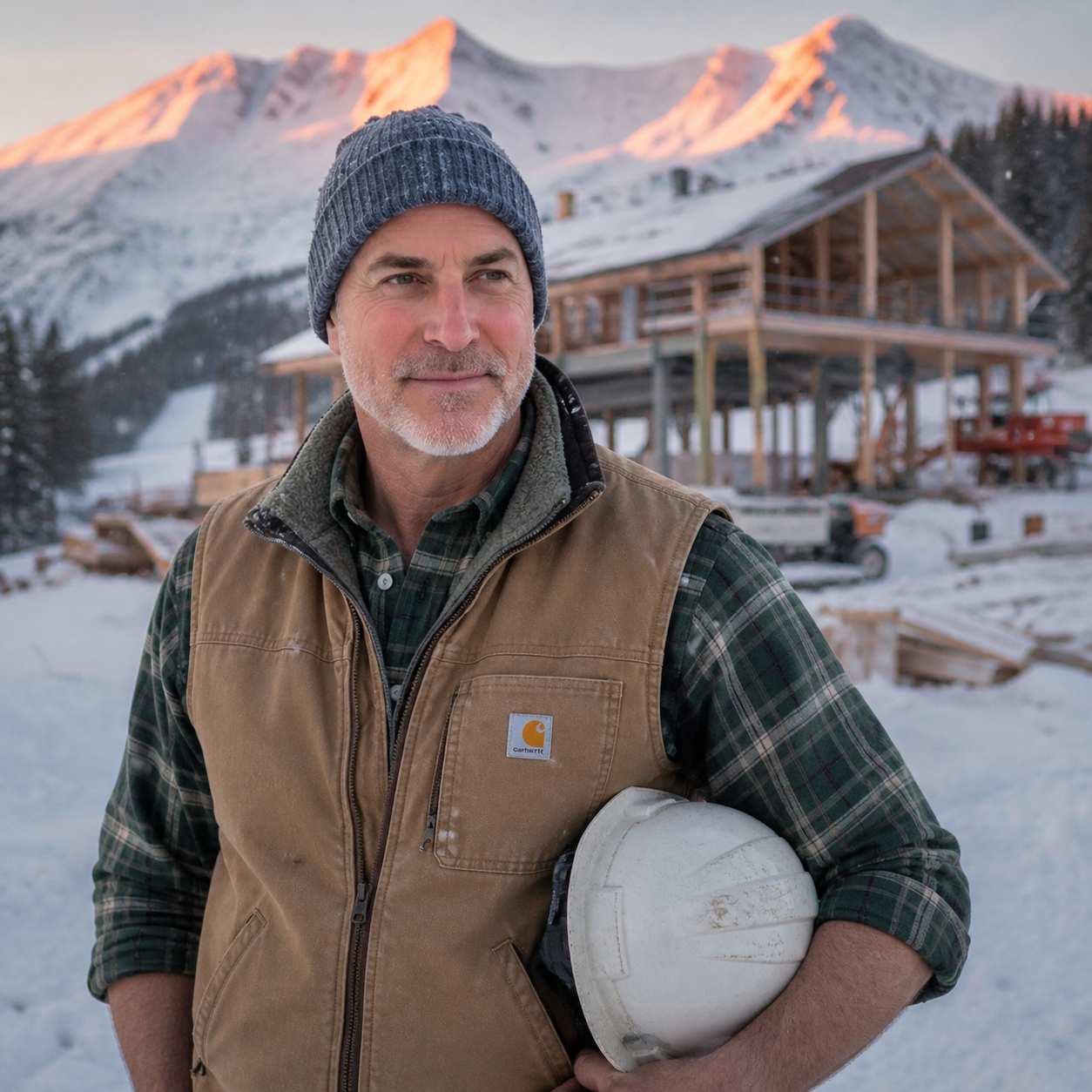
About the Author
Daniel is the founder of Dan Ski & Build, where he writes about the future of skiing from the rare vantage point of someone who lives in both worlds — the chairlift and the construction site. A lifelong skier and a builder by trade, he spends his days thinking about how mountain communities get built, broken, and rebuilt, and his weekends thinking about why the lift line is so long. He's currently working on several projects aimed at reimagining what a small American ski area can look like in the era of climate change, corporate consolidation, and a workforce that can no longer afford to live where it works. Locations to be announced soon. Until then, he wants to hear from you: what would your ideal mountain actually look like? Reach him at danskiandbuild.com or drop a comment on any post — he reads everything.