Record Visits, Broken Business Models: Why the Ski Industry Needs to Remember What it’s Selling

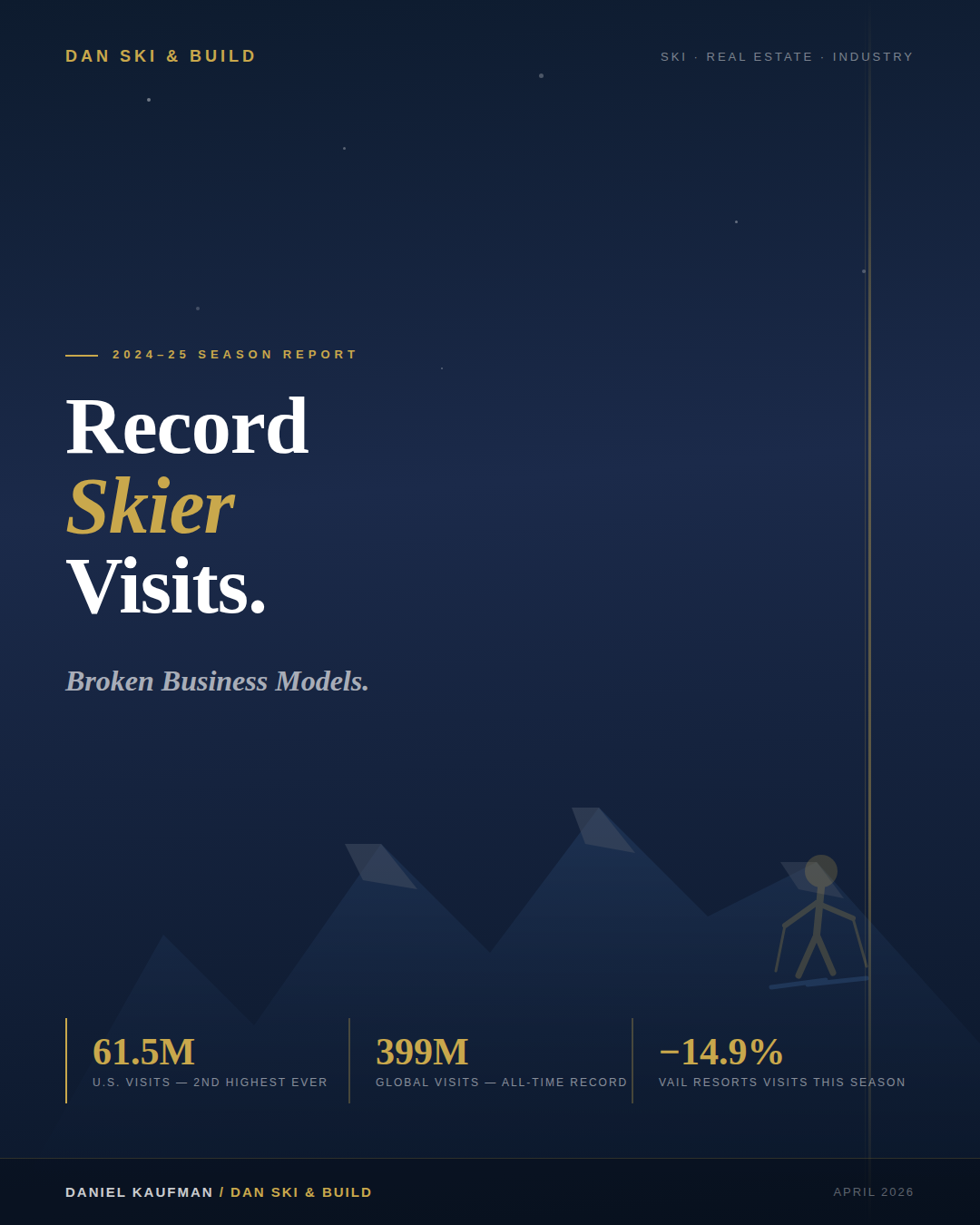
The numbers seem impossible to square. U.S. ski resorts logged 61.5 million visits in 2024-25, the second-highest season on record.
Globally, we hit 399 million skier visits. Demand has never been higher.
And yet, Vail Resorts—the behemoth that supposedly owns the industry—reported skier visits down 14.9 percent this season. Lift revenue down 5.6 percent. Ski school down 12 percent. Dining down 11.7 percent.
The data is telling a story nobody in the big resort business wants to hear: more people are skiing, but fewer are choosing to ski where the corporations are running the show.
The Corporate Playbook is Broken
Vail and Alterra have spent the better part of two decades convinced that the ski business works like any other commodity market. Consolidate supply. Control distribution. Raise prices. Squeeze ancillary revenue. Rinse and repeat. They’ve built it into a machine—the Epic Pass, the Ikon Pass, a network designed to capture the economically rational skier and lock them into a system.
But skiing isn’t economic. It’s experiential. It’s emotional. It’s personal.
When you optimize a ski resort for corporate earnings, what you’re actually optimizing for is density, throughput, and spend-per-visit. You’re building lift lines instead of lift capacity. You’re raising day-ticket prices so high that casual skiers are priced out, then wondering why the casual skier market—your growth engine—has vanished. You’re staffing mountains like retail operations instead of sanctuaries. You’re doing what the spreadsheet says, not what the skier needs.
The result: Vail’s flagship resorts are ranked as the least enjoyable places to ski in America. Park City Mountain dropped from number 15 to number 29 in the industry rankings. Okemo fell from 10 to 19. Mammoth Mountain, owned by Alterra, fell 14 spots.
Meanwhile, nine of the top 10 independent resorts in the West came in unranked just last year. Grand Targhee went from obscurity to number six. Banff Sunshine made number three.
The skier’s vote is in. And they’re voting with their legs.
Who Actually Runs the Ski Industry?
Here’s the thing: skiers aren’t running these mountains anymore. Accountants are. Financial engineers are. Private equity firms concerned with EBITDA multiples and quarter-over-quarter growth are.
The independent operators? They still remember that a ski resort is built on passion.
The GM at Pats Peak, Kris Blomack, put it perfectly: “We’re kind of like a little city when we’re up here operating. People come and they buy a lift ticket, but we’re also feeding them. We’re also taking care of the kids.”
That’s not a financial statement. That’s a stewardship statement. And it’s working. Independent resorts are thriving.
The Indy Pass, which aggregates over 120 independently owned mountains, has become a real competitor. Season pass penetration at smaller resorts is climbing. Ancillary revenue—food, beverage, ski school, rentals—is outpacing lift ticket revenue. Margins are healthy. Customers are loyal. Resorts are profitable.
You can take care of your skier. You can deliver an exceptional product. You can foster community. And you can still make money.
The Greed Factor
But there’s a difference between making money and extracting it.
Vail raised the Epic Pass price again this year—eight percent across the board. It raised day tickets above $300 at some locations. It’s been raising prices in a steady march that hasn’t slowed even as visits collapse. And each time they raise prices, more skiers walk.
Alterra’s Ikon Pass started at $999 in 2020. It’s $1,249 now. Same logic. Same results. It works until it doesn’t.
The math is simple: if your business model depends on raising prices faster than you’re losing customers, you’re operating on borrowed time. Eventually, the line breaks. The person who shows up twice a year with their family—the person you should care about most—starts thinking about whether this is worth $300 plus parking plus rentals plus lunch plus the whole production. They decide it isn’t. They don’t come back. And unlike the passholder, you’ve lost them forever.
Greed isn’t a feature of the ski industry. It’s a bug.
The Rebuild
So how do you rebuild this?
First, remember that you’re not running a financial instrument. You’re running a mountain. The financial returns come after you’ve created something people love, not before.
Second, decentralize power back to the mountains. Stop optimizing global networks for pass sales. Stop treating each resort like a node in a yield-management algorithm. Let the people who actually operate the mountains—who spend winter there, who know the snow, who live in the community—make decisions about their mountains.
Third, invest in the actual experience. Expand lift capacity instead of restricting it with higher prices. Hire passionate ski industry veterans, not rotation managers from other hospitality sectors. Fund ski school. Build real food and beverage programs instead of mall-food concessions. Create an environment where a skier can show up, have an exceptional day, and actually afford to do it again.
Fourth, recognize that there’s a generational moment happening. Record skier visits nationally is a gift. Use it to build loyalty, not to raise prices. The skier who learns to love skiing at an independent mountain—at Taos, at Grand Targhee, at a hundred smaller mountains—is a skier who might eventually help you build your company. The skier who gets priced out at a Vail resort at age 30 is a skier you’ve lost.
The Bifurcation is Real
You can already see the industry splitting. Mega-resorts like Vail are consolidating market share, raising prices, and watching their volume collapse. Independent resorts and smaller operators are gaining market share, maintaining pricing discipline, and thriving with loyal customers who feel like they’re part of something.
One model is extracting value from skiing. The other is creating it.
Right now, the independents are winning. And they’re winning because someone remembered that the best business model is one built on serving your customer first, and profits follow.
The ski industry didn’t forget how to ski. It forgot why it matters.
About the Author
Daniel Kaufman is a real estate developer, investor, and lifelong skier with 25+ years of experience building and operating across the country. He has developed and delivered thousands of units spanning market-rate, affordable, and mixed-use projects across ten states. Daniel brings the same practitioner-first lens he applies to real estate to his analysis of the ski industry — where he is also an active property owner, pass holder, and resort operator. He writes at the intersection of mountains, markets, and the business of building things that last.
About Dan Ski & Build
Dan Ski & Build is an independent publication at the crossroads of skiing and real estate. It covers the business of ski resorts, mountain town development, real estate trends in ski communities, and the forces reshaping the industry — from corporate consolidation to the rise of independent operators. Written by a developer who skis and a skier who builds, Dan Ski & Build offers a perspective you won’t find in the trade press: honest, data-grounded, and unapologetically passionate about the mountains.