Brodie Mountain: $200M Dream or Another False Start?

Dan Ski & Build · New Ashford, Massachusetts · April 2026
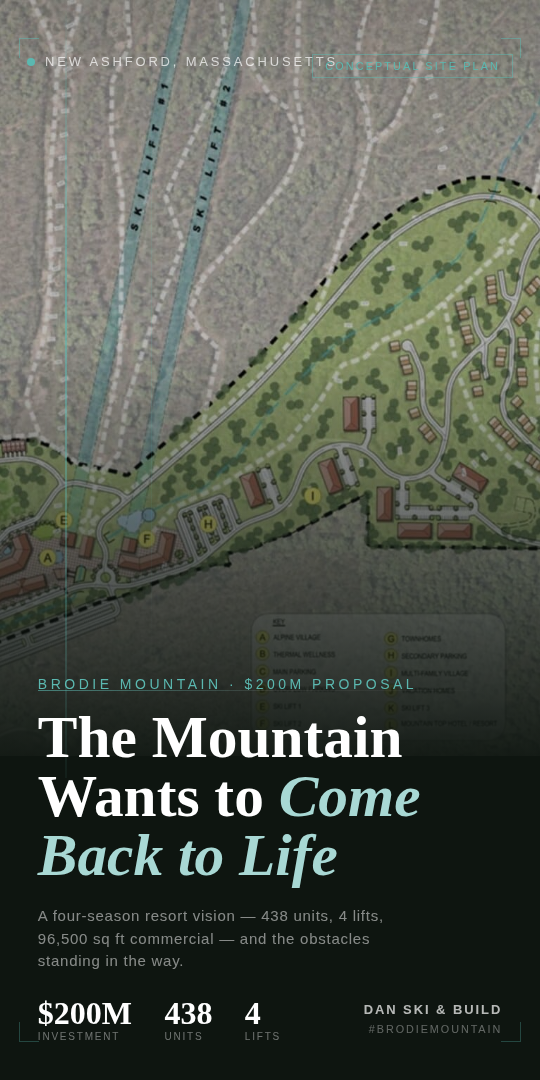
Brodie Mountain went dark in 2002. Sold again in late 2023. And now, more than two decades after its last run, a $200 million plan wants to bring it roaring back — not just as a ski area, but as a full-blown, four-season destination resort in the Berkshires.
We hadn’t heard much after the 2023 sale. But over the past month, some genuinely surprising news has come out of Western Massachusetts. A new development team has been making the rounds with a conceptual vision that, if it came to fruition, would transform one of New England’s most storied abandoned ski hills into what they’re calling a “premier all-season mountain resort.”
Here’s what’s on the table — and why it’s not as simple as it sounds.
The Vision
The Base Area
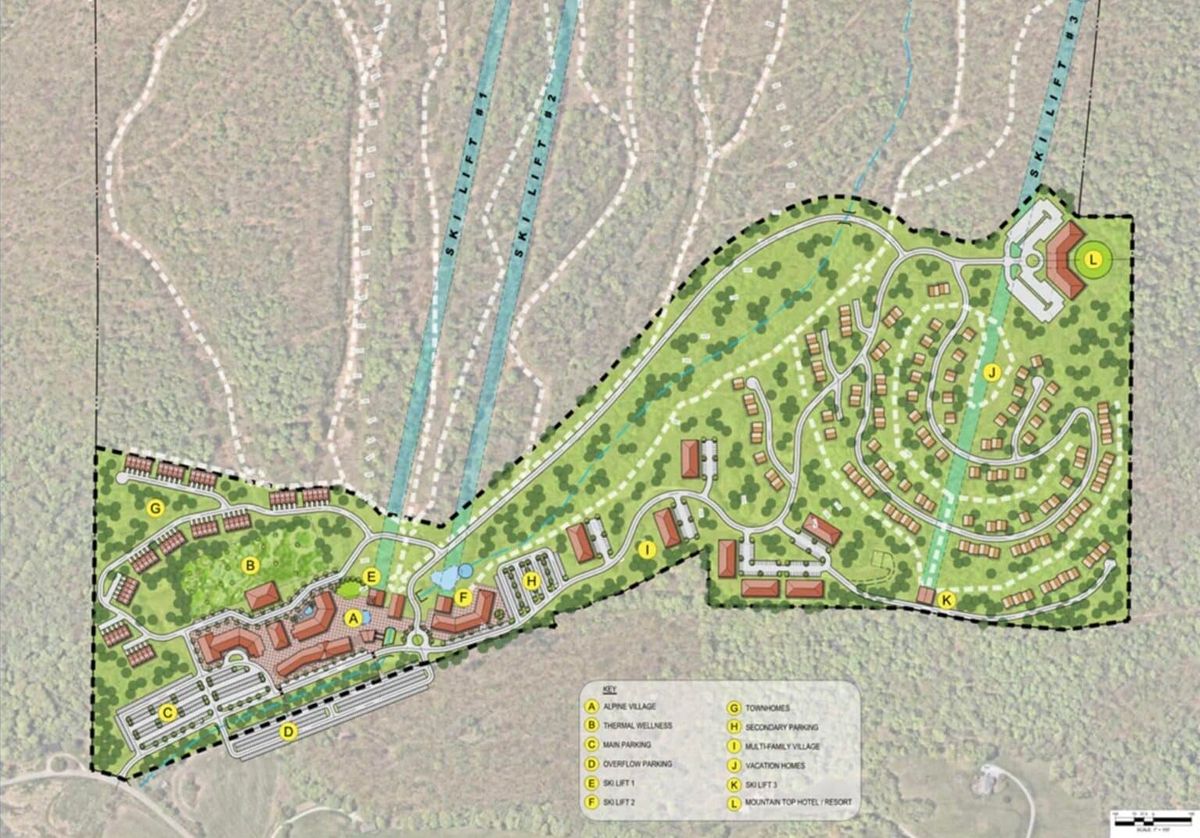
The proposed base village is substantial. We’re talking 438 housing units across a mix of hotel rooms, townhomes, multi-family buildings, and 24 units tucked inside what the developers are describing as an Irish-themed Christmas village — which is either charming or confusing depending on your disposition.
Commercial space clocks in at 96,500 square feet, with a mix of restaurants, retail, a brewery, a spa, an amphitheater, and event venues. As a base area concept goes, it’s ambitious — and well-rounded for what a modern resort destination needs to stay viable year-round.
The Mountain
Four lifts would service the ski terrain, with cross-country trails rounding out the winter offering. Come summer, the mountain shifts to mountain biking and connects into the Shaker Ridge trail network. The upper mountain could feature a lodge with a restaurant and an observation deck — the kind of asset that generates revenue in all seasons and creates a genuine sense of place.
On paper, this is a complete resort concept. Not just a ski area bolted onto a base lodge, but a real attempt at a four-season destination.
📺 Watch the full pitch to the New Ashford Planning Board here: https://reflect-willinet.cablecast.tv/store-3/13195-New-Ashford-Planning-Board-Meeting-3-24-26-v1/vod.mp4
It should be noted that what was presented is conceptual and does not represent the final proposal the team intends to submit.
The Obstacles Are Real
The Deed Restriction
This is the big one. The prior owner — and potential nearby competitor, Jiminy Peak — placed a deed restriction on the property in the early 2000s prohibiting lift-served downhill skiing for 30 years. Private skiing is technically permitted, but the developers don’t appear interested in that route. Their instinct is to figure something out, or wait it out.
As they put it: “We’d probably do private skiing or figure something out — or wait until it expires. By the time you develop something like this and build it out, it’s going to take quite a while anyway.”
That’s a pragmatic framing — but it’s also an uncomfortable reality: the mountain in your mountain resort won’t be open for skiing at launch.
Community Infrastructure Gaps
New Ashford is a small town with genuine limitations the development team acknowledged:
• Fire safety: The fire department lacks a ladder truck for taller buildings. Developers say they’ll keep buildings shorter — which constrains what’s actually buildable.
• Education: No town school. Growth means the town absorbs transportation costs, which complicates any significant population increase.
• Elevation limits: Restrictions apply above 1,500 feet, limiting upper-mountain development.
• Conservation: Part of the land carries conservation designations that further constrain buildable area.
• Community trust: Prior failed revival attempts have left locals intrigued but skeptical. That trust will need to be earned, not assumed.
If this moves forward, the town will also need meaningful developer contributions around employee housing and water infrastructure — not minor line items in a rural Western Massachusetts community.
Bottom Line
I love the ambition and want to see this place come back to life. But there are real missing pieces between this conceptual plan and a shovel in the ground. The deed restriction is a significant structural hurdle. The infrastructure gaps are solvable but require genuine commitment and capital. And community buy-in in a small town with a history of broken promises takes time to build.
This is worth watching — but it’s a long road from a Planning Board pitch to an open resort.
Daniel Kaufman is a Los Angeles-based real estate development and investment firm with over 25 years of experience across multifamily, mixed-use, workforce housing, resort, and AI-driven infrastructure. He publishes The Kaufman Report — a direct, data-grounded take on real estate markets, capital deployment, and development strategy that cuts through mainstream media narratives with operator-level insight.
Daniel’s active projects span ground-up construction, data center development, and workforce housing platforms across California, Vermont, and beyond. He is the founder of Convivium Living and Oldivai, a modular workforce housing platform, and holds interests in resort development.
Follow The Kaufman Report on Substack at danielkaufmanre.substack.com and connect with Daniel on LinkedIn, Instagram, and X.
@danskiandbuild